
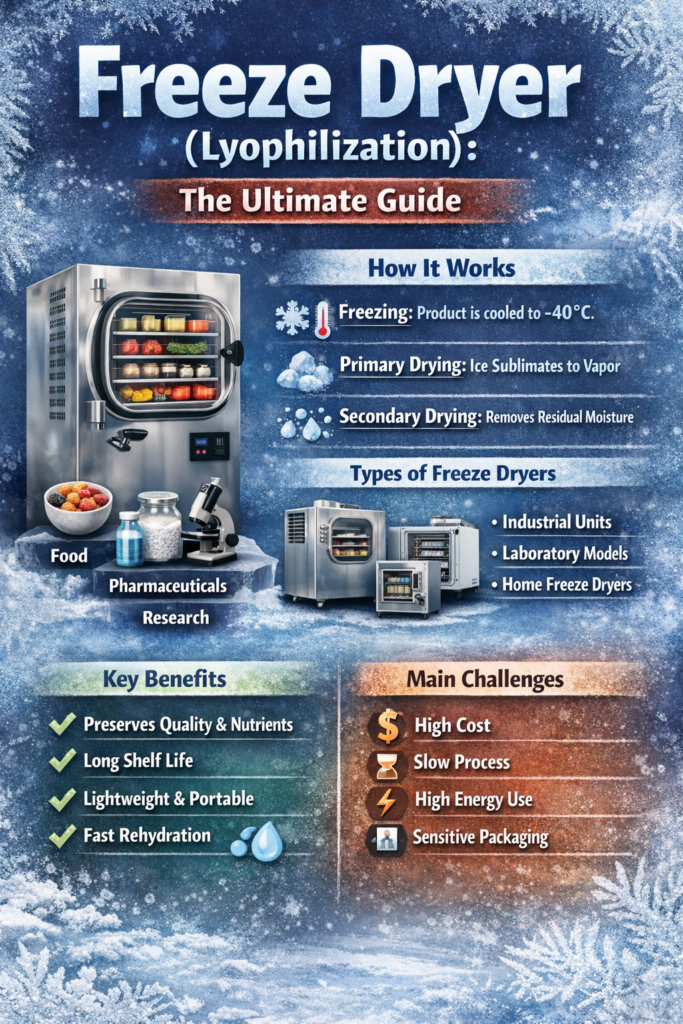
In today’s world, preserving the quality, nutrients, and longevity of products — from food to pharmaceuticals — is critical. Freeze drying, also known as lyophilization, has emerged as the most advanced method for achieving this. This article dives deep into the science, technology, applications, and benefits of freeze dryers, providing a complete understanding for both industry professionals and enthusiasts.
What Is a Freeze Dryer?
A freeze dryer is a machine designed to remove water from a substance through a process called sublimation, where ice transforms directly into vapor without passing through a liquid phase. Unlike traditional drying methods that rely on heat, freeze dryers maintain the structural integrity, flavor, and nutrients of products by operating at very low temperatures and under a vacuum.
This unique approach is why freeze drying is the preferred method for sensitive materials such as vaccines, probiotics, fruits, and high-end culinary ingredients.
The History of Freeze Drying
The concept of freeze drying is centuries old.
- Ancient Techniques: The Incas in South America preserved potatoes in the freezing Andean mountains.
- Late 19th Century: Richard Altmann developed early freeze-drying techniques for biological tissues.
- Early 1900s: Advances in vacuum technology allowed more controlled sublimation.
- World War II: Freeze drying was widely used to preserve blood plasma, penicillin, and other critical materials for medical use.
Modern freeze drying has since evolved into a sophisticated industrial process, vital in pharmaceuticals, biotechnology, food preservation, and research.
How Does a Freeze Dryer Work?
Freeze drying is a three-stage process that removes moisture while preserving the product’s structure and properties.
1. Freezing
The product is rapidly cooled to extremely low temperatures, often below −40 °C. Free water inside the material solidifies into ice crystals. Rapid freezing ensures smaller ice crystals, which helps maintain the product’s original texture.
2. Primary Drying (Sublimation)
Under a vacuum, the frozen water sublimates — converting directly from ice to vapor. Gentle heat is applied to encourage sublimation without melting the ice. This stage removes around 95% of the moisture while retaining the structural and chemical integrity of the product.
3. Secondary Drying (Desorption)
Residual water molecules that remain bound to the material are removed by slightly increasing the temperature under vacuum. After this stage, moisture content typically drops below 5%, producing a shelf-stable, lightweight, and easily storable product.
Key Principle: Freeze drying exploits the phase diagram of water. Under low pressure, ice can sublimate without becoming liquid, which preserves delicate materials that would otherwise collapse under heat.
Types of Freeze Dryers
Freeze dryers are available in various scales to meet specific needs:
- Industrial Freeze Dryers
Large units used by food manufacturers, pharmaceutical companies, and biotech firms to process high volumes efficiently. - Laboratory Freeze Dryers
Compact systems designed for research labs to preserve biological samples, enzymes, proteins, and microbial cultures. - Home Freeze Dryers
Consumer-grade machines for preserving fruits, vegetables, and meals. While slower and less energy-efficient, they enable small-scale freeze drying at home.
Applications of Freeze Dryers
Freeze drying is versatile and used across numerous industries:
1. Food Industry
- Preservation of fruits, vegetables, meats, and ready meals
- Production of instant coffee, drink powders, and powdered herbs
- Lightweight camping and astronaut foods
Freeze drying maintains flavor, color, texture, and nutrients better than conventional drying methods. Rehydration restores the product close to its original form.
2. Pharmaceuticals and Biotechnology
- Stabilizing vaccines, injectable drugs, and biologics
- Preserving enzymes, proteins, and microbial cultures
The process ensures biological activity remains intact until the product reaches the patient.
3. Research and Laboratories
- Storage of genetic materials, plant tissues, and rare experimental substances
- Preservation of enzymes, microbes, and sensitive reagents
4. Cosmetics and Personal Care
- Stabilization of botanical extracts, peptides, and active ingredients
- Enhances shelf life and formulation stability
5. Conservation and Historical Preservation
- Drying water-damaged books, manuscripts, and artifacts
- Maintains structural integrity of valuable or delicate objects
Advantages of Freeze Drying
1. Superior Quality Preservation:
Maintains taste, texture, color, and nutrients better than traditional drying.
2. Long Shelf Life:
Products resist microbial growth and oxidation due to extremely low moisture content.
3. Lightweight and Convenient:
Dehydrated products are lighter, making storage and transportation easier.
4. Rapid Rehydration:
Freeze-dried products absorb water quickly and regain almost their original structure.
5. Preserves Biological Activity:
Ideal for pharmaceuticals, enzymes, and probiotics, ensuring efficacy over time.
Drawbacks and Limitations
Despite its advantages, freeze drying has some challenges:
- High Initial Cost: Equipment and energy requirements are expensive.
- Time-Intensive: Full freeze drying cycles can take several hours to days.
- Energy Consumption: Both freezing and vacuum maintenance are energy-intensive.
- Sensitive Packaging: Once dried, products must be sealed to prevent moisture absorption.
Future Trends in Freeze Drying
Innovation is focusing on:
- Continuous Freeze Drying: Improves efficiency and reduces batch cycle times for industrial applications.
- Hybrid Methods: Combining freeze drying with microwave or infrared energy to reduce processing time and energy use.
- Smart Monitoring: Advanced sensors and AI control systems for precise temperature and vacuum management.
These trends aim to make freeze drying faster, more energy-efficient, and widely accessible.
Conclusion
A freeze dryer is a cutting-edge preservation system capable of maintaining the quality, nutrients, and biological activity of sensitive products. Its applications span food, pharmaceuticals, biotechnology, research, cosmetics, and historical preservation. Despite its high costs and time requirements, the advantages — superior preservation, long shelf life, lightweight products, and rapid rehydration — make it indispensable in modern science and industry.
By understanding the science, stages, and applications of freeze drying, businesses and consumers can make informed decisions about preserving products with maximum efficiency and quality.
FAQs About Freeze Dryers
Q1: What is a freeze dryer?
A: A freeze dryer, or lyophilizer, is a machine that removes water from products by sublimation — turning ice directly into vapor under low temperature and vacuum. This preserves nutrients, flavor, texture, and biological activity.
Q2: How does a freeze dryer work?
A: Freeze drying occurs in three stages:
- Freezing: Product is cooled to form ice crystals.
- Primary Drying (Sublimation): Ice converts directly to vapor under vacuum.
- Secondary Drying (Desorption): Remaining water is removed, leaving the product dry and shelf-stable.
Q3: What are the types of freeze dryers?
A: There are three main types:
- Industrial freeze dryers for large-scale production.
- Laboratory freeze dryers for research and biological samples.
- Home freeze dryers for small-scale food preservation.
Q4: What products can be freeze-dried?
A: Freeze drying is used for:
- Foods like fruits, vegetables, meats, and instant coffee
- Pharmaceuticals and vaccines
- Biological samples in research labs
- Cosmetics and personal care ingredients
- Historical artifacts and documents
Q5: What are the advantages of freeze drying?
A: Freeze drying preserves nutrients, flavor, and texture, extends shelf life, reduces weight, allows rapid rehydration, and maintains biological activity of sensitive products.
Q6: Are there any disadvantages of freeze drying?
A: The main drawbacks include high equipment and energy costs, long processing times, and the need for proper packaging to prevent moisture absorption.
Q7: Can I use a freeze dryer at home?
A: Yes, home freeze dryers are available for small-scale food preservation. They are slower and less efficient than industrial models but allow convenient storage and long shelf life for household food items.
Q8: What industries use freeze dryers?
A: Freeze dryers are widely used in the food industry, pharmaceuticals, biotechnology, research laboratories, cosmetics, and conservation of historical artifacts.
Q9: How long can freeze-dried products last?
A: When stored properly in airtight containers, freeze-dried products can last several years without losing quality, flavor, or nutrients.
Q10: What’s the future of freeze drying technology?
A: Innovations include continuous freeze drying, hybrid energy methods to reduce time and energy usage, and smart monitoring systems for precise control of temperature and vacuum.